Science Highlights
I research the baryon cycle and galactic outflows across the majority of the history of the Universe, from redshift z~0 (now) to z~6 (less than 1 billion years after the Big Bang), using spectroscopic data spanning rest-frame UV to submillimeter wavelengths.
I am currently an active member of two international collaborations:
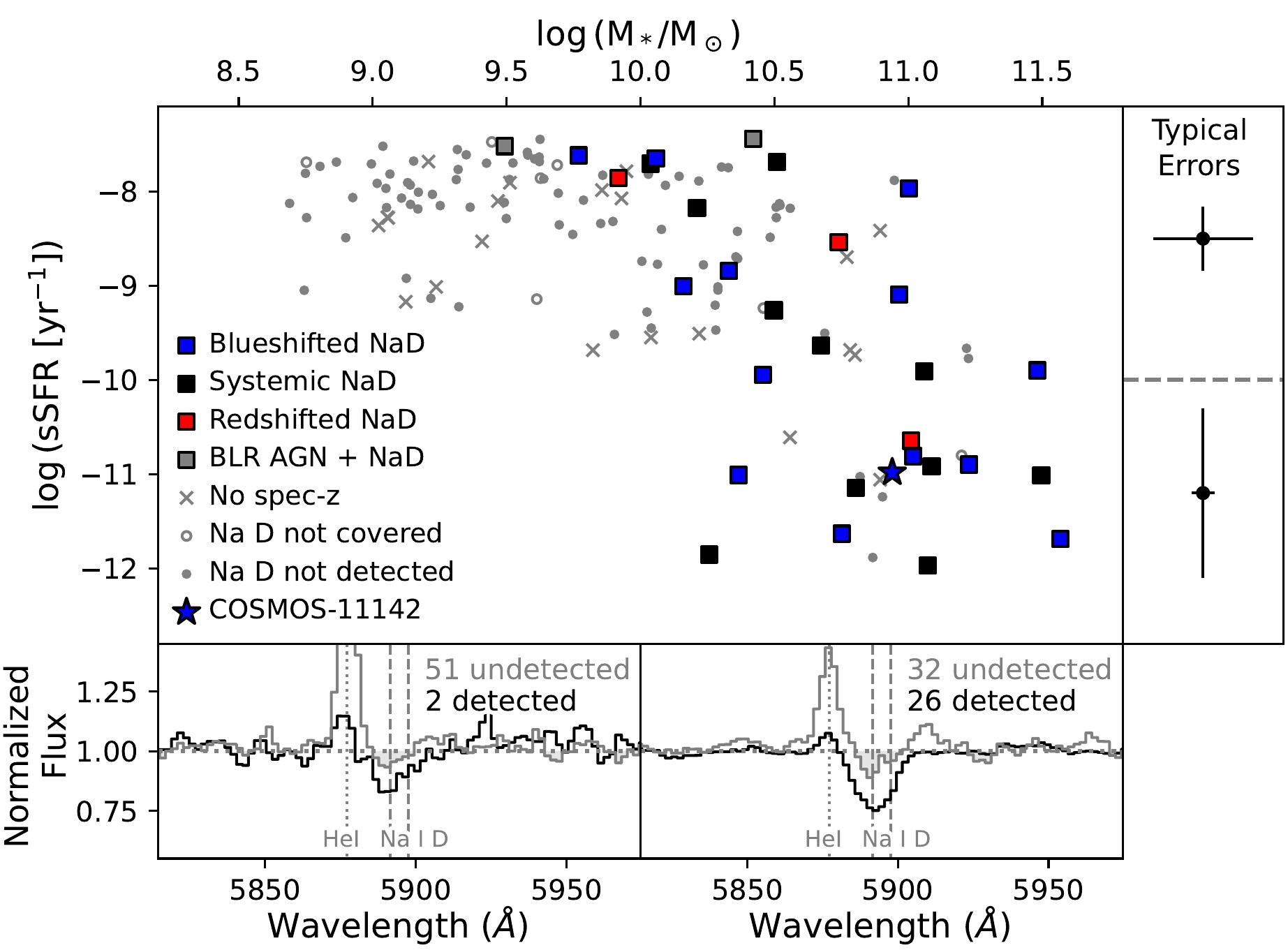
- Blue Jay: A JWST survey providing long-slit optical-to-near-infrared spectral of approximately 150 main sequence galaxies at z~2, providing the first comprehensive view of the absorption line properties of galaxies at this epoch. We found the first evidence for widespread, powerful AGN-driven neutral gas outflows which may be a dominant driver of early fast quenching (read more).
- ASKAP-FLASH: A blind search for HI 21cm absorption at 0.4 < z < 1.0 using the Australian SKA Pathfinder. I am co-leading efforts to obtain optical spectroscopy of the HI host galaxies, providing valuable insights into a wide range of topics including AGN fuelling and feedback, the CGM and star-formation, and galaxy quenching.
Click the links below to find out more about my past and current research projects: